Overview
Check the FAQ if you have any issues after configuration!
Configuration Types
Sources and Clients are configured using:
- environmental (ENV) variables
- client/source specific json config files
- an all-in-one json config file
MS will parse configuration from all configuration types. You can mix and match configurations but it is generally better to stick to one or the other.
- ENV
- File
- File AIO
MS will parse environmental variables present in the OS/container when it is run. This method means MS does not require files to run.
Use ENV-based configuration if...
Config Example
For Docker container...
docker run -e "SPOTIFY_CLIENT_ID=yourId" -e "SPOTIFY_CLIENT_SECRET=yourSecret" ...
For Docker Compose
services:
    multi-scrobbler:
        image: foxxmd/multi-scrobbler
        environment:
            - SPOTIFY_CLIENT_ID=yourId
            - SPOTIFY_CLIENT_SECRET=yourSecret
            - MALOJA_URL=http://domain.tld:42010
            - MALOJA_API_KEY=1234
            # ...
        # ...
For a local/node installation export variables before running...
SPOTIFY_CLIENT_ID=yourId SPOTIFY_CLIENT_SECRET=yourSecret npm run start
MS will parse configuration files located in the directory specified by the CONFIG_DIR environmental variable. This variable defaults to:
- Local installation ->
PROJECT_DIR/config - Docker ->
/config(in the container) -- see the install docs for how to configure this correctly
Use File-based configuration if...
- You have many Sources
- You have many of each type of Source you want to scrobble from IE 2x Plex accounts, 3x Spotify accounts, 1x Funkwhale...
- You have more than one scrobble Client you want to scrobble to IE multiple Maloja servers
- You want only to scrobble to specific Clients
- You need to setup more advanced configuration for a Source/Client
- Most Source/Clients only support basic configuration through ENV, all configuration is possible using File/AIO
- There are example configurations for all Source/Client types and AIO config located in the
/configdirectory of this project. These can be used as-is by renaming them to.json. - For docker installations these examples are copied to your configuration directory on first-time use.
- There is also a kitchensink example that provides examples of using all sources/clients in a complex configuration.
Each file is named by the type of the Client/Source found in below sections. Each file as an array of that type of Client/Source.
Example directory structure:
/CONFIG_DIR
    plex.json
    spotify.json
    maloja.json
Config Example
[
  {
    "name": "MySpotify",
    "enable": true,
    "clients": [],
    "data": {
      "clientId": "a89cba1569901a0671d5a9875fed4be1",
      "clientSecret": "ec42e09d5ae0ee0f0816ca151008412a",
      "redirectUri": "http://localhost:9078/callback",
      "interval": 60
    }
  }
]
MS will parse an all-in-one configuration file located in the directory specified by the CONFIG_DIR environmental variable. This variable defaults to:
- Local installation ->
PROJECT_DIR/config/config.json - Docker ->
/config/config.json(in the container) -- see the install docs for how to configure this correctly
Use AIO-based configuration if...
- You have many Sources
- You have many of each type of Source you want to scrobble from IE 2x Plex accounts, 3x Spotify accounts, 1x Funkwhale...
- You have more than one scrobble Client you want to scrobble to IE multiple Maloja servers
- You want only to scrobble to specific Clients
- You need to setup monitoring/webhooks
- You want to setup defaults for all Sources/Clients
The AIO config also enables setting default options for sources/clients as well as global options for MS itself.
- An example AIO config files can be found in the project directory at
/config/config.json.example - For docker installations this example is copied to your configuration directory on first-time use.
- There is also a kitchensink example that provides examples of using all sources/clients in a complex configuration.
Explore the schema for this configuration, along with an example generator and validator, here
Config Example
{
  "debugMode": false,
  "disableWeb": false,
  "sourceDefaults": {
    "logPayload": false,
    "logFilterFailure": "warn",
    "logPlayerState": false,
    "scrobbleThresholds": {
      "duration": 30,
      "percent": 50
    },
    "maxPollRetries": 1,
    "maxRequestRetries": 1,
    "retryMultiplier": 1.5
  },
  "clientDefaults": {
    "maxRequestRetries": 1,
    "retryMultiplier": 1.5
  },
  "sources": [
    {
      "type": "spotify",
      "enable": true,
      "clients": ["myConfig"],
      "name": "mySpotifySource",
      "data": {
        "clientId": "a89cba1569901a0671d5a9875fed4be1",
        "clientSecret": "ec42e09d5ae0ee0f0816ca151008412a",
        "redirectUri": "http://localhost:9078/callback"
      }
    }
  ],
  "clients": [
    {
      "type": "maloja",
      "enable": true,
      "name": "myConfig",
      "data": {
        "url": "http://localhost:42010",
        "apiKey": "myMalojaKey"
      }
    }
  ],
  "webhooks": [
    {
      "name": "FirstGotifyServer",
      "type": "gotify",
      "url": "http://localhost:8070",
      "token": "MyGotifyToken",
      "priorities": {
        "info": 5,
        "warn": 7,
        "error": 10
      }
    },
    {
      "type": "ntfy",
      "name": "MyNtfyFriendlyNameForLogs",
      "url": "http://localhost:9991",
      "topic": "MyMultiScrobblerTopic",
      "username": "Optional",
      "password": "Optional",
      "priorities": {
        "info": 3,
        "warn": 4,
        "error": 5
      }
    }
  ]
}
Setup Sources and Clients
See the Configuration Types above for your options for creating Source and Client configurations.
- Reference Scrobble Sources for what Sources are available
- Reference Scrobble Clients for what Clients are available
Each entry for a Source/Client includes a Configuration section that describes how to configure it using a configuration type.
Secrets Interpolation
When using File or AIO Configuration, Multi-Scrobbler can interpolate Environmental Variables into your json files. This can be used, for example, to keep sensitive data (like Last.fm Client/Secret) out of your configuration files so that they can be committed to git.
Multi-scrobbler will look for patterns in text fields within all of your json files:
- Some part of the text field matches:
[[MY_ENV]] - Is replaced by the value of the Environmental Variable named
MY_ENV
Example
Given this Last.fm File config:
[
  {
    "name": "myLastFmClient",
    "configureAs": "client",
    "data": {
      "apiKey": "[[MY_APIKEY]]",
      "secret": "[[MY_SECRET]]",
      "redirectUri": "http://localhost:9078/lastfm/callback"
    }
  }
]
And these environmental variables, in this scenario set through environment in the docker compose installation:
MY_APIKEY=a89cba1569901a0671d5a9875fed4be1
MY_SECRET=ec42e09d5ae0ee0f0816ca151008412a
The resulting json multi-scrobbler would use:
[
  {
    "name": "myLastFmClient",
    "configureAs": "client",
    "data": {
      "apiKey": "a89cba1569901a0671d5a9875fed4be1",
      "secret": "ec42e09d5ae0ee0f0816ca151008412a",
      "redirectUri": "http://localhost:9078/lastfm/callback"
    }
  }
]
Caveats
- ENV variable names/interpolation keys are case-insensitive
- Interpolation only works for string values within json. This cannot be used for numbers, booleans, objects, etc...
Missing ENVs
Multi-scrobbler will not throw an error if the environmental value is not found. Instead, it will leave the string as-is and log a warning (WARN level) with the names of the missing environmental variable names like so:
WARN : [App] [Sources] [spotify Secrets] Matched: None | Unmatched: SPOTIFY_SECRET
ENV Name Collisions
Verify that interpolation keys/environmental variable names you will use do not collide with existing ENV names used by multi-scrobbler. Use the docs search to verify the name you want to use is not already used elsewhere by multi-scrobbler.
Application Options
These options affect multi-scrobbler's behavior and are not specific to any source/client.
Base URL
Defines the URL that is used to generate default redirect URLs for authentication on spotify and lastfm -- as well as some logging hints.
- Default =>
http://localhost:9078 - Set with ENV
BASE_URLorbaseUrlall-in-one configuration - If protocol is
httpor no protocol is specified MS will try to use port9078-- to override this explicitly set the port or usehttps
Useful when running with docker so that you do not need to specify redirect URLs for each configuration.
Example
EX Lastfm Redirect Url is BASE_URL:PORT/lastfm/callback (when no other redirectUri is specified for lastfm configuration)
BASE_URL | Redirect URL |
|---|---|
192.168.0.101 | http://192.168.0.101:9078/lastfm/callback |
http://my.domain.local | http://my.domain.local:9078/lastfm/callback |
http://192.168.0.101/my/subfolder | http://192.168.0.101:9078/my/subfolder/lastfm/callback |
BASE_URL | Redirect URL |
|---|---|
my.domain.local:80 | http://192.168.0.101:80/lastfm/callback |
my.domain.local:9000 | http://my.domain.local:9000/lastfm/callback |
192.168.0.101:4000/my/subfolder | http://192.168.0.101:4000/my/subfolder/lastfm/callback |
https://192.168.0.101 | https://192.168.0.101:443/lastfm/callback |
Caching
Multi-scrobbler caches some activities to persist important data across restarts, reduce external API calls, and make some actions faster.
All of the activities below are always cached in-memory with an optional, configurable secondary store for persistence.
- Scrobbles
- Auth Data
- Transform API Calls
Queued and Failed Scrobbles are cached so that any un-scrobbled data you have is persisted across restarts of multi-scrobbler.
By default, this data use a Secondary File store, configured for you automatically.
If you have configured a persisted volume/bind mount for configuration (/config is mounted in docker compose) then you are already done. If you are not persisting this directory then you should consider setting up Valkey Cache for this.
Configuration
Use any Secondary Cache, the config examples below show the default values:
- ENV
- AIO
| Environmental Variable | Required? | Default | Description |
|---|---|---|---|
CACHE_SCROBBLE | No | file | The cache type to use |
CACHE_SCROBBLE_CONN | No | /config |
{
    "cache": {
        "scrobble": {
            "provider": "file",
            "connection": "/config"
        }
    },
    // ...
}
Authentication sessions/tokens/etc... are cached for quicker requests and for persistence across restarts.
By default, this data use a Secondary File store, configured for you automatically.
If you have configured a persisted volume/bind mount for configuration (/config is mounted in docker compose) then you are already done. If you are not persisting this directory then you should consider setting up Valkey Cache for this.
Configuration
Use any Secondary Cache, the config examples below show the default values:
- ENV
- AIO
| Environmental Variable | Required? | Default | Description |
|---|---|---|---|
CACHE_AUTH | No | file | The cache type to use |
CACHE_AUTH_CONN | No | /config |
{
    "cache": {
        "auth": {
            "provider": "file",
            "connection": "/config"
        }
    },
    // ...
}
API Calls to external (metadata) services used to Enhance Scrobbles, like calls to Musicbrainz, can be cached to avoid duplicate calls and speed up scrobble transformations.
By default, these calls are only cached in memory. If you wish for cached calls to be persisted across restarts then setup Valkey Cache.
Configuration
Use any Secondary Cache, the config examples below show the default values:
- ENV
- AIO
| Environmental Variable | Required? | Default | Description |
|---|---|---|---|
CACHE_METADATA | No | The cache type to use | |
CACHE_METADATA_CONN | No |
{
    "cache": {
        "metadata": {
            "provider": "valkey",
            "connection": "yourConnectionStringHere"
        }
    },
    // ...
}
Secondary Caching Configuration
The type of cache used, and its connection properties, can be configured through ENV or AIO config.
- File
- Valkey
File cache is stored in the CONFIG_DIR directory using the pre-defined file name ms-[cacheName].cache.
- ENV
- AIO
Example
| Environmental Variable | Required? | Default | Description |
|---|---|---|---|
CACHE_SCROBBLE | No | file | The cache type to use |
CACHE_SCROBBLE_CONN | No | /config | The directory, within the container, to store the cache file |
Example
{
    "cache": {
        "scrobble": {
            "provider": "file",
            "connection": "/config"
        }
    },
    // ...
}
Valkey is an open-source fork of Redis.
Adding Valkey container to multi-scrobbler
A valkey container can be added to the multi-scrobbler docker compose stack:
services:
  multi-scrobbler:
  # ...
  # adding everything below
  valkey:
    image: valkey/valkey
    volumes:
      - valkeydata:/data

volumes:
  valkeydata:
    driver: local
Use redis://valkey:6379 as the connection string in the configurations below.
The connection string used by multi-scrobbler to connect to your Valkey instance must be in the form:
redis://HOST_IP:HOST_PORT
- ENV
- AIO
Example
| Environmental Variable | Required? | Default | Description |
|---|---|---|---|
CACHE_METADATA | Yes | valkey | The cache type to use |
CACHE_METADATA_CONN | Yes | The host/IP and port to connect to EX: redis://192.168.0.120:6379 |
Example
{
    "cache": {
        "metadata": {
            "provider": "valkey",
            "connection": "redis://192.168.0.120:6379"
        }
    },
    // ...
}
Debug Mode
Turning on Debug Mode will
- override and enable all optional "debugging" options found in configuration
- set log output to DEBUG
Use this as a shortcut for enabling output that can be used for troubleshooting and issue reporting. Be aware that logs will likely be VERY noisy while Debug Mode is on. You should only have this mode on while gathering logs for troubleshooting and then turn it off afterwards.
To set debug mode either add it to AIO config.json
{
    "debugMode": true,
    "sources": [...],
    // ...
}
or set the ENV DEBUG_MODE=true
Disable Web
If you do not need the dashboard and/or ingress sources, or have security concerns about ingress and cannot control your hosting environment, the web server and API can be disabled.
Any ingress-based sources will be unusable (Webscrobbler, etc...) if this is disabled.
Disable using either:
- ENV
DISABLE_WEB=true - In All-in-One File use the top-level property
"disableWeb": true
Monitoring
Upstream Services Status
A status page for monitoring the reachability of public services used by some Sources/Clients is available at
https://status.multi-scrobbler.app
This monitor runs on a VPS and checks the uptime of actual APIs for these services, not just landing pages. On a ~minute interval it checks:
- Listenbrainz API
- Musicbrainz API
- CoverArtArchive API
- Last.fm API
- A few MS-hosted support services
Webhook Configurations
Webhooks will push a notification to your configured servers on these events:
- Source polling started
- Source polling retry
- Source polling stopped on error
- Scrobble client scrobble failure
Webhooks are configured in the AIO config.json file under the webhook top-level property. Multiple webhooks may be configured for each webhook type.
Example
{
  "sources": [
    //...
  ],
  "clients": [
    //...
  ],
  "webhooks": [
    {
      "name": "FirstGotifyServer",
      "type": "gotify",
      "url": "http://192.168.0.100:8070",
      "token": "abcd"
    },
    {
      "name": "SecondGotifyServer",
      "type": "gotify",
      //...
    },
    {
      "name": "NtfyServerOne",
      "type": "ntfy",
      //...
    },
    //...
  ]
}
Gotify
Refer to the config schema for GotifyConfig
multi-scrobbler optionally supports setting message notification priority via info warn and error mappings.
Example
{
  "type": "gotify",
  "name": "MyGotifyFriendlyNameForLogs",
  "url": "http://192.168.0.100:8070",
  "token": "AQZI58fA.rfSZbm",
  "priorities": {
    "info": 5,
    "warn": 7,
    "error": 10
  }
}
Ntfy
Refer to the config schema for NtfyConfig
multi-scrobbler optionally supports setting message notification priority via info warn and error mappings.
Example
{
  "type": "ntfy",
  "name": "MyNtfyFriendlyNameForLogs",
  "url": "http://192.168.0.100:9991",
  "topic": "RvOwKJ1XtIVMXGLR",
  "username": "Optional",
  "password": "Optional",
  "priorities": {
    "info": 3,
    "warn": 4,
    "error": 5
  }
}
Apprise
Refer to the config schema for AppriseConfig
multi-scrobbler supports stateless and persistent storage endpoints as well as tags/
Example
{
  "type": "apprise",
  "name": "MyAppriseFriendlyNameForLogs",
  "host": "http://192.168.0.100:8080",
  "urls": ["gotify://192.168.0.101:8070/MyToken"], // stateless endpoints
  "keys": ["e90b20526808373353afad7fb98a201198c0c3e0555bea19f182df3388af7b17"], //persistent storage endpoints
  "tags": ["my","optional","tags"]
}
Health Endpoint
An endpoint for monitoring the health of sources/clients is available at GET http://YourMultiScrobblerDomain/api/health
- Returns
200 OKwhen everything is working or500 Internal Server Errorif anything is not - The plain url (
/api/health) aggregates status of all clients/sources -- so any failing client/source will make status return 500- Use query params
typeornameto restrict client/sources aggregated IE/api/health?type=spotifyor/api/health?name=MyMaloja
- Use query params
- On 500 the response returns a JSON payload with
messagesarray that describes any issues- For any clients/sources that require authentication
/api/healthwill return 500 if they are not authenticated - For sources that poll (spotify, yt music, subsonic)
/api/healthwill 500 if they are not polling
- For any clients/sources that require authentication
Prometheus
A Prometheus export endpoint is available at GET http://YourMultiScrobblerDomain/api/metrics
It includes metrics for:
- Count of discovered plays per Source
- Count of Queued/Scrobbled/Deadletter scrobbles per Client
- Number of issues per Source/Client
- If any of these metrics is > 0 it means your Source/Client is not operating normally
- Caching metrics
Additionally, general process metrics like cpu and memory usage can be enabled with the env PROMETHEUS_FULL=true
Example Usage
Update your Prometheus Configuration file (usually at /etc/prometheus.yml) to add a job to the scrape_configssection like this:
scrape_configs:
  #
  # ...your other jobs are here
  #
  - job_name: multi-scrobbler
    scrape_interval: 30s
    metrics_path: '/api/metrics'
    static_configs:
      - targets: ['myMultiscrobblerIp:9078']
Grafana Dashboard
Github user 4rft5 created a Grafana dashboard that uses the Prometheus metrics from above.
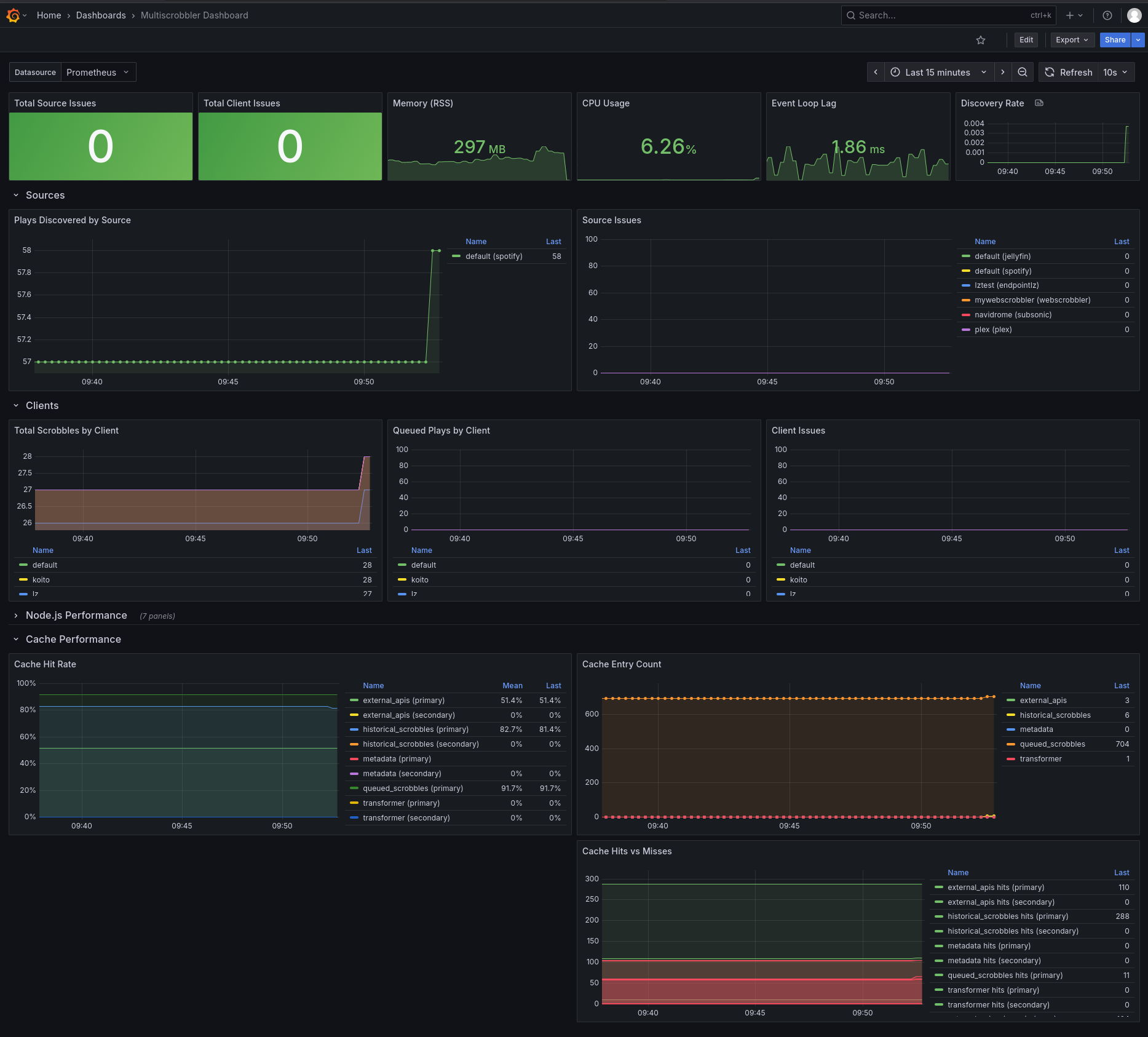
Download the json dashboard here: multiscrobbler-dashboard.json